
How to Play Stones
What Is Stones?
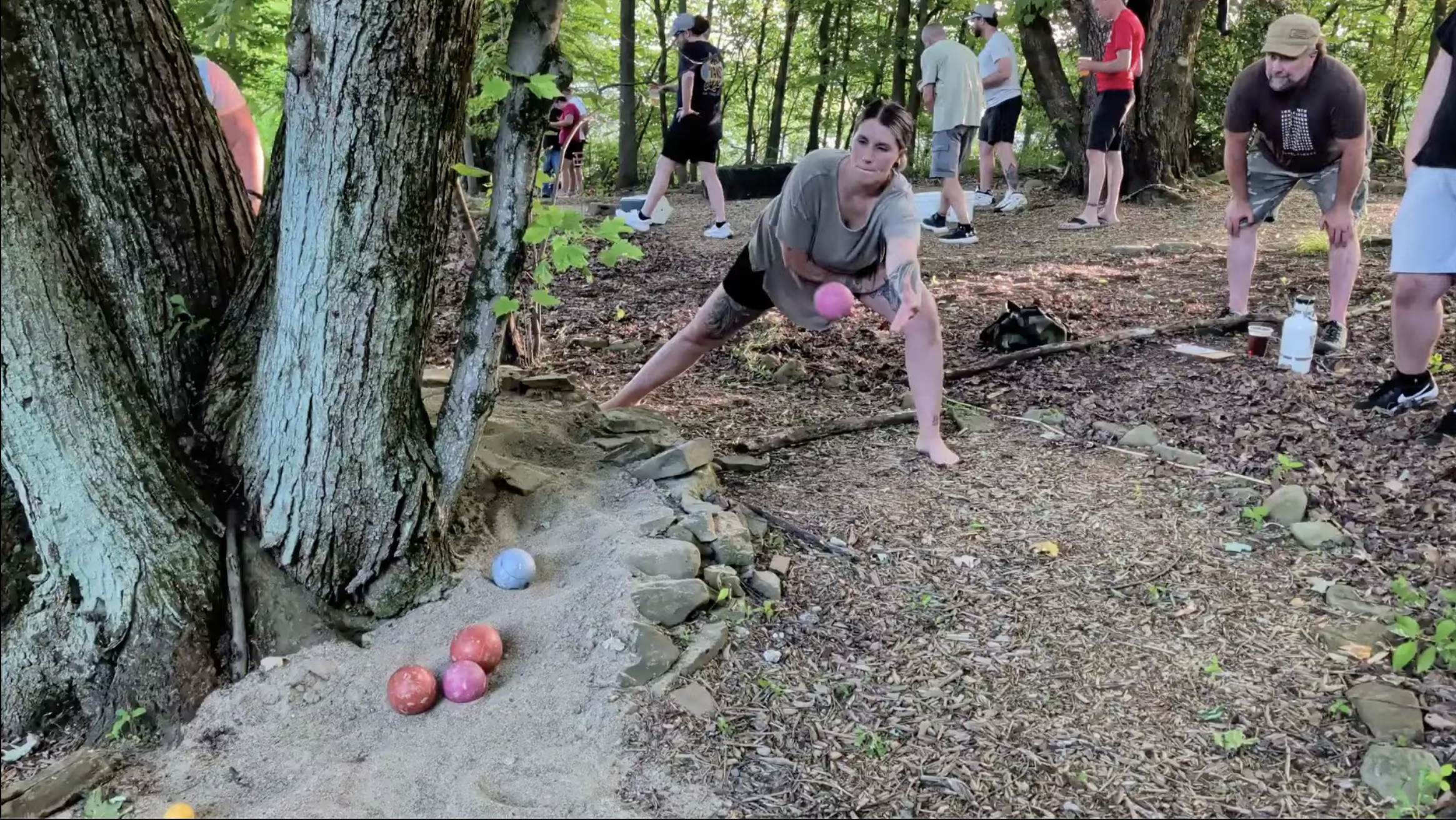
If you've never heard of Stones, here's the short version. It's a 2v2 outdoor throwing game that’s based on bocce but has elements from golf and many other sports in it.
You throw weighted stones across real terrain. You're trying to land closer to a small yellow ball called the Mark than the other team. Sounds simple. It really isn't. There’s a ton of strategy. There's a zone on the course that doubles all your points, and there's a water hazard rule that makes your teammate pay for your bad throws.
It's one of those games that takes five minutes to understand and about five games to stop being surprised by.
The Course
A Stones course has five stretches. Think of them like holes on a golf course. Each stretch has three things: a throwing base where players stand to throw, clearly marked in-bounds and out-of-bounds zones, and a landing zone at the far end.
Stretches are usually between 15 and 75 feet long and they progress naturally from one to the next. The surfaces you're throwing across can be anything. Dirt, gravel, sand, grass, pine needles, mulch. Courses can also include natural or man-made obstacles. Logs, roots, slopes, water, boulders, even fire.
Built into the course is a separate play zone called the X. More on that later, but know that it exists independently from the five stretches and is accessible from at least two of them, usually including stretch 4 or 5.
Players and Equipment
Standard Stones is 2v2. Two teams, two players each. The rules also allow for 1v1 and 4v4 formats but 2v2 is the standard game.
Every player has four stones: one 90mm, two 100mm, and one 110mm. These are weighted resin balls. In team play you can share a set or each player can use their own. Stones with chips or breaks larger than a quarter are not legal to use. If a stone breaks during a round, only the largest piece counts for scoring that round.
In standard 2v2 play each player throws two stones per round, giving each team four stones total in play. In 1v1, each player throws all four of their stones. In 4v4, each player throws just one stone per round.
The Mark
The Mark is a 50mm yellow ball. It's the target every round. Every round starts with one player throwing the Mark from the throwing base of the current stretch.
For the Mark throw to be valid it has to travel more than 3 feet and land in bounds. If it doesn't, that same player throws again. If the second attempt also fails, or if the first throw lands in water, the other team takes over and throws the Mark instead.
The Mark can be knocked around by stones during play. That's completely legal and it happens constantly. Final position is what matters for scoring. The one outcome you're trying to avoid is knocking the Mark completely out of bounds. If that happens the round is canceled, all stones are collected, and the other team starts fresh with a new Mark throw.
If the Mark gets knocked behind the throwing line, that also counts as out of bounds. And if the Mark gets intentionally thrown out of bounds twice in a row by the same team, the opponent gets to either take over the Mark throw themselves or force that team to keep throwing until it lands legally.
If the Mark gets knocked off a landing twice during a game, both teams move back five feet and a second spot is placed five feet behind the original.
Stone Sizes and Why They Matter
This is where Stones gets more interesting than most people expect.
The 90mm is your precision stone. Smallest of the three, easiest to control, best for placing tight to the Mark when you need accuracy. The 110mm is your power stone. Heavier, harder to place with precision, but built for disruption. You throw it when you need to knock an opponent's stone out of position or make an aggressive play. The 100mm is the middle ground and you carry two of them, which gives you flexibility.
Every round you choose which two of your four stones to throw. That decision is one of the most strategic parts of the game. Are you sitting in a good position and playing it safe? Are you trying to move an opponent? Are you going for the X? Those choices accumulate over five stretches and they matter.
How a Round Plays Out
Once the Mark is established, the same team that threw it throws the first stone. If that stone lands in bounds it's established and the other team throws. If it doesn't land in bounds, that team keeps throwing until one stays in bounds.
From there the team that is NOT closest to the Mark keeps throwing, one stone at a time, until they either get closer than the opponent or run out of stones. Teammates alternate throws and choose their stone size each turn. Once the closer team throws, if they're still closer, the other team throws again. This continues until all eight stones are thrown.
After the final stone the round is scored and closed. Once a round is closed everything can be picked up and you continue play from there.
What Counts as In Bounds
A stone is in bounds if any part of it is within the marked boundary. It doesn't have to be fully inside. A stone that rolls out of bounds can also come back in via contact with another stone and it still counts.
Stones can legally make contact with the Mark, other stones, natural or artificial course features, out-of-bounds obstacles, and even spectators or animals if it's unintentional. If a stationary stone gets accidentally moved by a non-player it gets returned to its original position. If a moving stone hits a non-player, the throwing team gets a rethrow. If the round is significantly affected, the whole round gets replayed.
If a moving stone hits an actual player, that player's team forfeits a stone and the thrower gets a rethrow. If a player interferes with a resting stone, that team forfeits a stone and the round may be replayed with a penalty.
Throwing Out of Turn or Throwing the Wrong Stone
If a player accidentally throws an opponent's stone, they forfeit one of their own stones. The opponent can also choose to keep the result if it benefits them.
If a player throws out of turn, that throw is declared dead the moment the stone is released. If the course layout was affected by that throw, the referee resets the field or replays the round.
How Scoring Works
After all eight stones are thrown the referee uses the naked eye to determine which stone is closest to the Mark. Players can go check for themselves but the ref's call stands unless a challenge is used.
The team with the closest stone earns 1 point plus 1 additional point for every stone they have that is closer than the opponent's nearest stone. If all four of your team's stones are closer than all four of theirs, you score 4 points plus a 2-point bonus for a total of 6 points. That's the maximum you can score in a single standard round.
If the two closest stones are exactly equidistant from the Mark it's a tie and neither team scores that round.
After the final stone, any stone can be physically measured to settle a disputed call.
Moving Through the Course
After a round is scored, a Spot is placed at the final resting position of the Mark. The next thrower must have one foot fully covering the Spot when they throw. No part of their body can touch the ground closer to the Mark than the Spot while throwing and before the stone comes to rest. Violate that and you forfeit the throw. Any stones that were disrupted by the foot violation get replaced.
All Mark throws must progress forward on the course. A stretch can be skipped but its landing still has to be played. Once a stretch is played for the first time, the next round in that stretch starts from wherever the Mark last landed.
The landing of each stretch has to be played before moving on to the next stretch. The Mark can reach a landing either by a throw or by deflection off another stone. A Mark can either be thrown or knocked onto a landing. If it gets knocked backward off a landing it's still in play as long as it's past the previous spot.
The Water Hazard
One of the most memorable rules in Stones.
If a player throws the Mark into water, it's an immediate forfeiture. The other team takes over the Mark throw. If a player throws a stone into water, their teammate has to discard one of their remaining stones. Not the player who made the bad throw. The partner. You suffer, but so does the person standing next to you.
The player who threw into the water still throws next. They don't get to sit out the consequences of their shot. If the Mark gets knocked into the water by a stone during play, the round is canceled and the other team throws the Mark to restart.
One interesting wrinkle: if a stone gets knocked OUT of the water and lands in bounds during play, that stone counts as in bounds and is live. I’ve never seen this happen and would consider it an incredible act of luck.
The X
The X is the single most dramatic element in Stones and the thing that makes games feel live until the very last stone.
It's a separate play zone built into the course. Usually between 2 and 7 feet in diameter, surrounded by out-of-bounds on all sides, accessible from at least two stretches. You cannot play The X on the very first throw of the game.
The X activates when the Mark and at least one stone both come to rest on The X at the end of a round. When that happens every point scored that round is doubled. A standard 2-point round becomes 4. A 6-point round becomes 12.
If the Mark gets knocked off The X at any point during the round, the round is canceled. No points, restart.
After The X is played, the Mark can be thrown either to the current stretch or back to the previous one. Then resume forward progress.
If the Mark gets knocked back onto the regular course after being on The X, play continues normally but without the point doubling.
End of Game
After the fifth stretch is played and scored, the team with more points wins. But they have to win by 2. That rule alone keeps games alive longer than you'd expect.
Overtime
Overtime triggers if the score is tied or within 1 point after the final landing is played.
Run a coin toss. The team that held the lead most recently gets to call it. The winner of the toss picks between two options: choosing which stretch to start from or taking the first Mark throw.
Overtime plays exactly like regular rounds. It keeps going until one team builds a 2-point lead. That team wins.
Tournament Rules
If you're playing in a league or tournament a few additional rules apply on top of everything above. We’ll save that for another article.
Where to Play Right Now
Crooked Tongue Brewing in Edinburg, PA. A wooded course built behind the taproom. Open Thursdays, Fridays, and Saturdays from 4 to 10pm. This is also where the Thursday Night League runs every week.
We’re actively working on finding locations to build more courses. Let us know where you think the next one should go!
Get Your Own Set
Want to build your own course? Stone sets are available here. You don't need a big space or perfect terrain.
Follow along at instagram.com/pittsburghstones for course updates, league nights, and whatever we're throwing at next.